When the pricing table says “10 clients in your bundle”, there are two ways to read it. One is “I get ten accounts to hand out”. The other is “I can keep the books for ten clients”. It is the second, and the difference is not a nuance: it changes who does the work, who logs in and who pays for what.
First things first: your practice gets the whole of Factuza
This gets underrated when people look at the table, so we say it before anything else. With the practice licence your practice invoices its own work like any other client: quotes, invoices, expenses with receipt scanning, numbering series, recurring invoices and your own tax returns. The client bundle sits on top of that, not instead of it.
Put another way: you are not buying a tool for other people and staying outside it yourself. You are buying Factuza, plus the capacity to carry N clients inside it.
What a “client in your bundle” is
A taxpayer whose books you keep. They send you what comes in —their issued invoices, their receipts, their expenses— you enter it, and Factuza works out their position separately: their quarter, their returns, their chain of invoices with their tax number and their numbering.
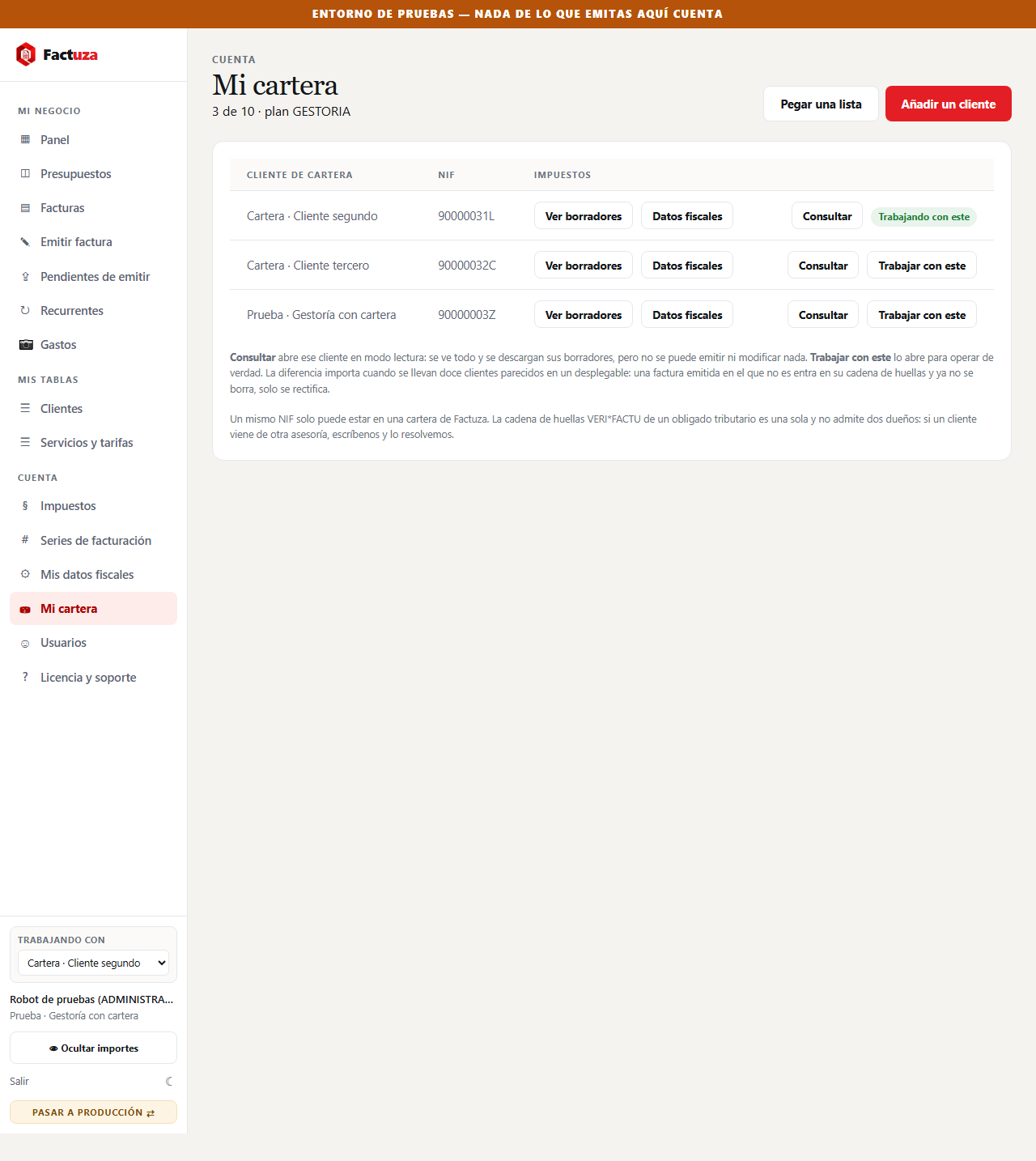
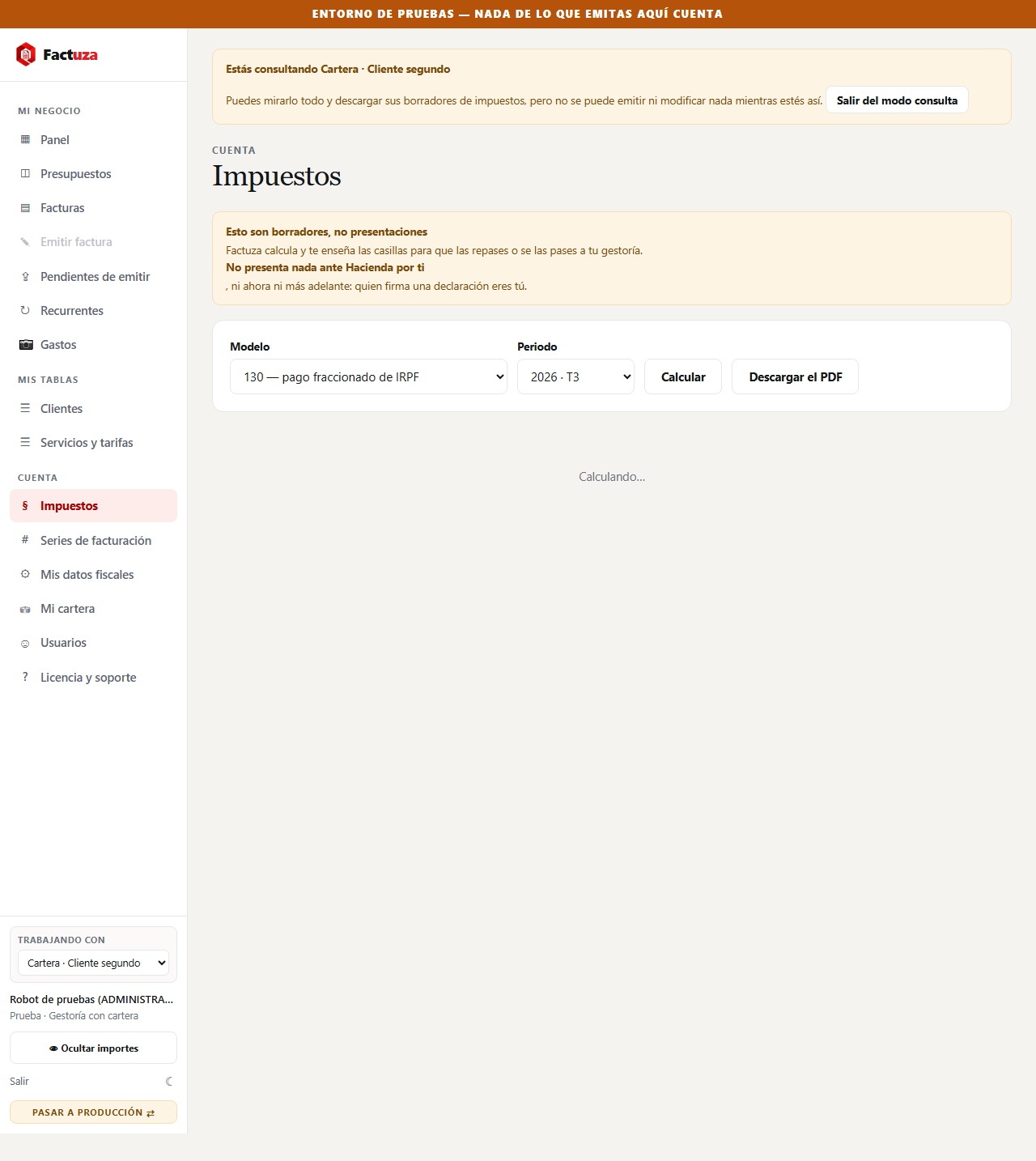
When you choose “Work on this one”, the whole application becomes that client's: you issue in their name, upload their expenses, produce their tax returns. When you have finished, you switch to the next. There is no logging out and back in with another password.
Registering them: you paste the list
Nobody is going to type twenty clients into a form when they have them in a spreadsheet. You paste them, in four columns: tax number, name or company name, registered tax address and F or J —sole trader or company.
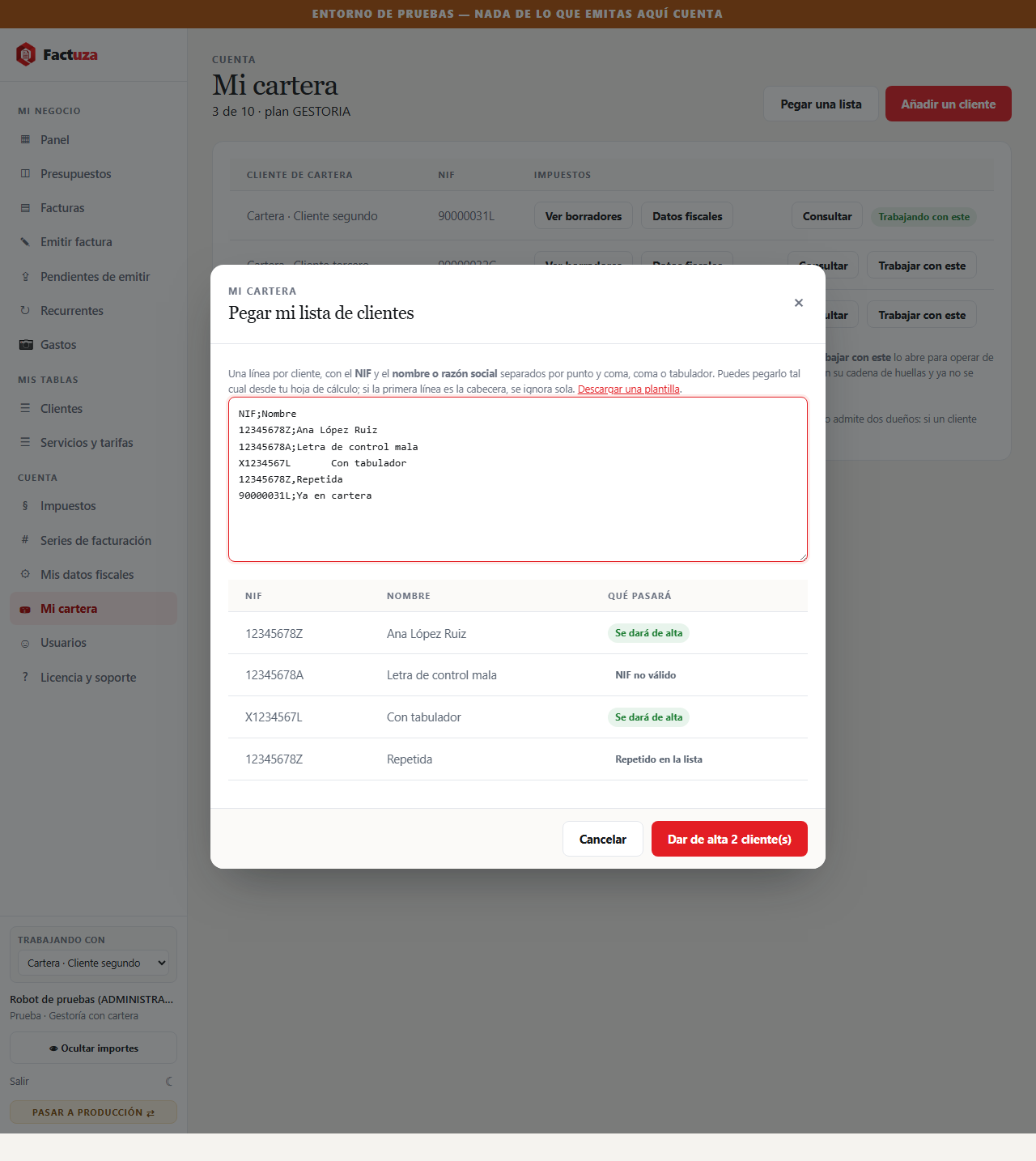
The last two columns are not bureaucracy of ours. The issuer's address is printed on every invoice and article 6 of Royal Decree 1619/2012 requires it: a client who goes in without one will issue incomplete invoices, so the screen tells you how many arrive with no address before it creates anything. And the F or the J decides whether they are taxed under income tax or corporation tax — entering a limited company as an individual leaves it on Modelo 130, which does not apply to it.
Your clients do not log in, and that is deliberate
A client in your bundle has no login. It is not an oversight: it is what makes the bundle cheap and the work yours. You have the tool, they send you the paperwork, and what they see is what you send them.
And there is an underlying reason that goes beyond price. All of a practice's clients sit inside the same account; letting them in as things stand would show them the entire client base, that is, the data of the practice's other clients — who very often are their competitors. Rather than open that door halfway, we would rather not open it.
And if a client wants to log in themselves?
Then they buy their own sole-trader licence, separate from your bundle. And you do not lose them: they stay in your client base, with whatever work you have inside, and you go on doing their tax work with whichever role they choose —from read-only through to issuing in their name. Nobody has to be invited and nothing has to be registered again: when they sign up, their account picks up the issuer that was already in your client base and the working relationship stays alive.
And they do not have to buy it themselves. You can buy it for them, at 30 % off the list price: €8.40 a month instead of €12. You charge them whatever you decide and the difference is entirely yours. It is the same thing you already do with the rest of their affairs, and it means the client does not have to sign up anywhere or enter a card. It is explained on the practices page.
What changes is who is in charge. While they are only in your bundle, you run them entirely. Once they have their own account, the control is theirs: they choose your permission in their settings, they can reduce it and they can end the relationship. On your dashboard you will see them as “Own account”, with whatever permission they have left you.
In passing, that client frees up a slot in your allowance for somebody else. Your bundle is working capacity: when somebody starts working on their own account, that capacity becomes available again.
One tax number, one chain
Worth knowing before it happens. A tax number can only be registered as an issuer once: its VERI*FACTU hash chain is a single chain and does not admit two owners. What exists is one issuer with one owner, not two copies.
That does not stop them being in your client base and having their own account at the same time: they are two different things. The owner is whoever controls the issuer —only one— and the client base is the working relationship, which stays alive on top. The only thing that cannot happen is the same tax number registering itself twice.
When one of your clients makes the jump, their issuer changes owner —it becomes theirs— with their invoices and their chain behind it. That happens automatically, the moment they sign up: there is no writing to us and no waiting for anybody. What does not change is the work: they stay in your client base and you go on logging in, now with whatever permission they give you.
The case that does have to be handled by hand is the other one: a tax number already registered as an issuer in another practice's client base, with no connection to you. There the registration stops dead on purpose, because moving a taxpayer from one client base to another means deciding first what happens to their history and their hash chain. You write to us and we sort it out. We would rather say it here than have it discovered on the day it happens.
In short
- Your practice: the complete Factuza, like any other client.
- Your client base: N clients whose books you keep, each with their own tax number, numbering and tax returns.
- Them: they neither need nor have an account. They send you the paperwork.
- Anyone who wants their own: a separate sole-trader licence. They stay in your client base and you go on keeping their books, with whatever permission they grant you.
- What you charge them for keeping their books is your decision. We do not set your selling price.
Factuza launches on 15 September 2026. If you run a client base and want to see how this fits yours, write to us and we will go through it together.